 Archos Labs
Why AI Pilots Stall and How to Fix the Real Cause
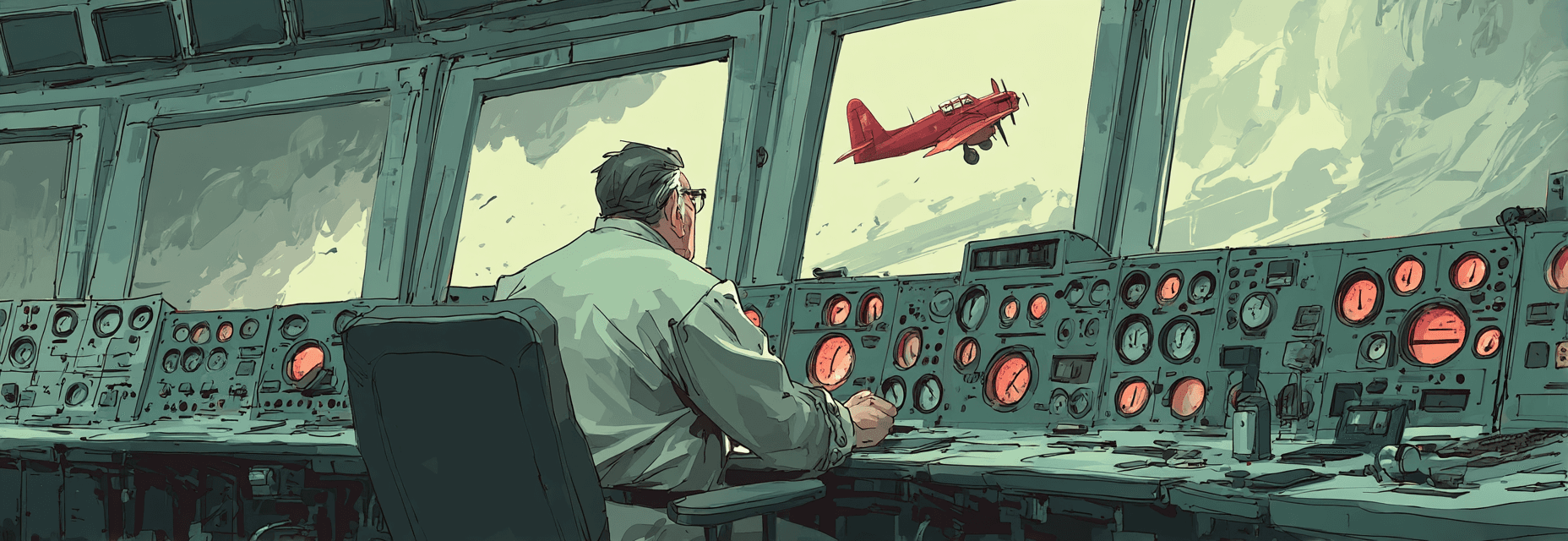
Most AI projects fail not because the tech is bad, but because executives misread the cause—like pilots who crash while staring at the wrong dial.
You’ve run twenty AI pilots this year. Three made it to production. None moved the P&L needle. The pattern isn’t random—it’s aerodynamic.
The stall you can’t see
A Cessna 172 stalls at 48 knots. Not because the engine quits but because the wing’s angle to the wind exceeds 16 degrees. The air stops flowing smoothly over the top. Lift vanishes. The plane drops.
Pilots watch the airspeed indicator and never see the angle of attack creep up. They pull back on the yoke, thinking more pitch will save them. It makes the situation worse.
AOPA’s 15-year analysis of 2,000 stall accidents shows the same story: 24% of all fatal general aviation crashes, half in the traffic pattern, 45% by pilots with commercial or ATP ratings. These aren’t novices. They’re people who’ve done the maneuver a hundred times. The problem isn’t skill—it’s what they’re trained to watch.
The AI equivalent of the wrong dial
Your AI pilot tracks adoption rate. It’s the airspeed indicator. Easy to measure, easy to report. If adoption is low, you blame the model or the vendor.
You swap out the LLM or clean the dataset and run another pilot. Adoption improves slightly. The project still stalls.
Workflow fit isn’t on the dashboard. It’s the angle of attack. The AI tool might generate perfect summaries. If the sales team still copies them into Salesforce by hand, the lift never happens.
The mismatch isn’t visible in the adoption report. Extra clicks no one tracks reveal it.
Spotify’s internal post-mortem on their 2023 AI playlist generator is a case in point. The model nailed personalization. Every adoption metric was hit.
The project died because the recommendation engine required a separate app—one not syncing with the main player. Users loved the playlists. They hated the friction. The approach was wrong.
The training trap
Aviation Safety Magazine’s 2017 analysis nails the training flaw: pilots learn to recognize stalls by symptoms—low speed, high nose attitude—not by the underlying mechanics. The curriculum reinforces the wrong variable.
Fixing this requires a different curriculum.
Your AI training does the same. Teams attend prompt-engineering workshops. You measure prompt literacy.
When the adoption rate climbs, you celebrate. You’re teaching them to watch the airspeed indicator while the wing stalls.
The Air Facts Journal contributor from 2020 argues recurrent training on recognition and recovery is the fix for aviation stalls. This approach focuses on symptoms. It hasn’t worked.
AOPA’s 15-year data shows stall rates holding steady despite more training. The problem isn’t volume—it’s variable.
The counterargument you’re already making
You’ll say the analogy breaks here. Aviation stalls have a single root cause—angle of attack. AI failures are messy.
Data quality and change management play roles. You’re not wrong. But the pattern holds: you’re measuring the wrong thing.
Gartner’s 2024 AI adoption report shows 95% of generative AI pilots fail to scale. The primary reasons include lack of clear business case and poor integration with existing workflows. Insufficient executive sponsorship also ranks high.
None of these relate to model quality. They’re all angle of attack.
The strongest defense of your current approach is following the playbook. Vendors sell adoption metrics. Consultants benchmark them. Boards ask for them.
Compliance with the wrong curriculum doesn’t prevent stalls. It ensures them.
How to design the bigger bet
Stop launching pilots. Start designing interventions.
- Pick one workflow touching revenue. Something moving a number on the income statement. A pricing tool or a dynamic discount engine.
- Instrument the angle of attack. Build a dashboard tracking workflow fit, not adoption. Measure extra clicks or workarounds. If the AI tool adds friction, kill it. No matter how good the model.
- Tie the budget to the P&L. If the project doesn’t move the number in 90 days, reallocate the funds. Extensions don’t happen. Lessons aren’t learned. The market doesn’t care about your lessons.
- Fire the vendor who sold you the airspeed indicator. The one promising adoption rates would solve everything. They’re selling you a stall.
The stall you can’t recover from
The most dangerous stall doesn’t happen at 500 feet. It occurs at 5,000, in smooth air, on a routine flight.
Pilots relax. Its angle increases. The wing quits.
Recovery becomes harder because altitude is lacking. Your AI pilots are stalling at 5,000 feet.
Panic isn’t the issue. You’re tweaking the dials. The fix isn’t more altitude. It’s a different instrument.


Read next

The Execution Layer
Why AI Pilots Succeed But Never Reach Production
Your AI pilot worked. So why is it still a pilot? Four structural reasons enterprise AI stalls between demo and deployment, and the questions that fix it at…
3 min read

AI as Strategy
From MVP to Meaning: Why AI Pilots Fail at Scale
47 pilots, 3 in production. The failure isn't technical — it's strategic. Here's why AI initiatives stall between proof-of-concept and scale, and what…
4 min read

The Execution Layer
Why Most AI Pilots Die Before Reaching Production
AI pilots don't die because the model failed. They die because no one planned for governance, ownership, or operational scaffolding before the demo ended.
5 min read