 Archos Labs
Data Governance for AI Starts Before the First Prompt
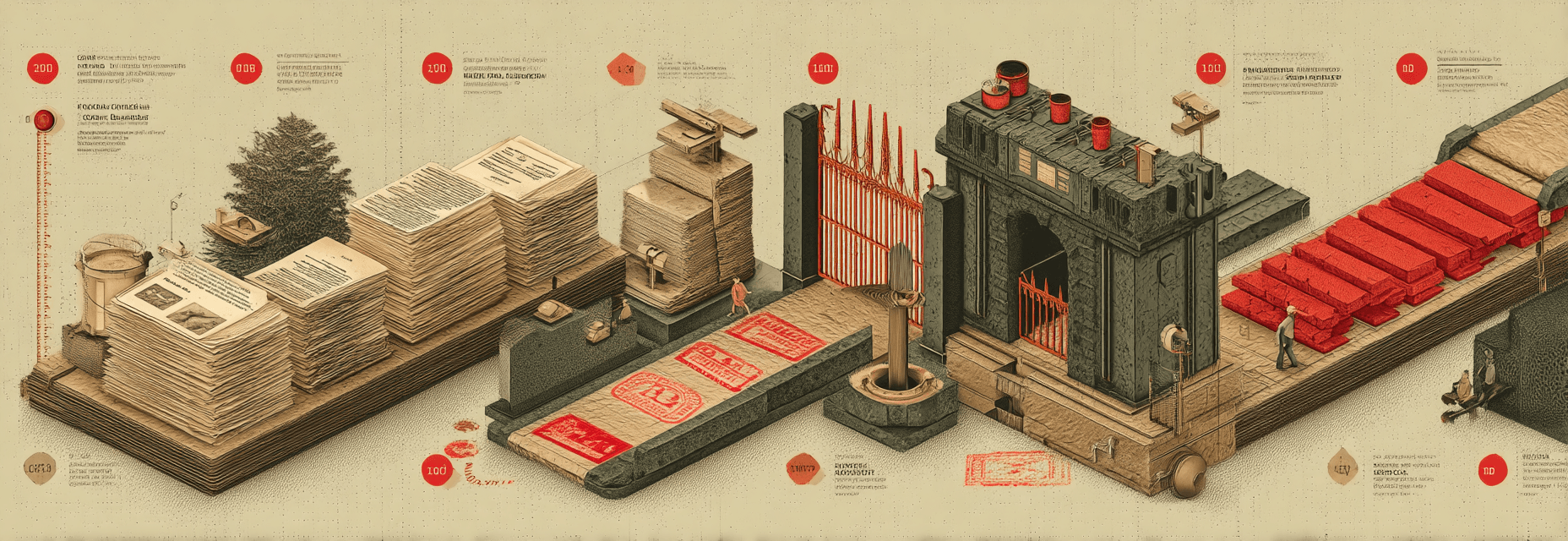
Data governance for AI means stopping bad data from reaching your agents, not just logging it after the fact.
Most companies don’t have a data governance problem. They have a timing problem. They’re trying to fix AI hallucinations by duct-taping the outputs, instead of blocking the poison that caused them in the first place.
Why Real Governance Happens at Ingestion
By the time a hallucinated answer hits your user, it’s already too late. You’ve taught the system that garbage is acceptable.
The real failure wasn’t in the prompt. It was upstream—in the lack of quality gates before your RAG pipeline ever touched the data. If the input was misclassified, outdated, or unverified, then your agents didn’t hallucinate. They obeyed.
Too many teams think of data governance for AI as metadata or dashboards. That’s compliance theater. Real governance shows up as friction: blocking records that don’t belong, halting ingestion when schemas shift, killing bad inputs before they touch production memory.
The Villain Is the Soft Yes
In most AI pipelines, ingestion defaults to “accept.”
Scrape everything. Vectorize everything. Store everything.
But not everything should be turned into a vector. Not every file deserves semantic weight.
A broken PDF with misaligned table columns shouldn’t be “cleaned later.” A marketing slide deck from 2019 shouldn’t have equal authority to a verified policy document. Yet in most RAG systems, they all get embedded the same way: into a single soup of “knowledge.”
That’s how you end up with agents recommending workflows that no longer exist. That’s how a chatbot tells a customer the claim form is still manual when it went digital three years ago.
And when leadership asks why the model “got it wrong,” the answer isn’t parameter tuning. It’s the absence of a gate.
Data Governance for AI Means Saying No Early
Think of each stage in your ingestion pipeline as a border crossing.
Real governance looks like:
- Hard schema checks with auto-rejection
- Recency filters that reject stale documents
- Contextual classifiers that block irrelevant formats
- Confidence scoring thresholds that drop misaligned embeddings
- Human-in-the-loop review on sensitive document sets
This is not post-hoc audit logging. This is pre-ingestion enforcement.
The goal isn’t to tag bad data after it spreads. It’s to prevent it from entering the system in the first place.
Just like you wouldn’t let raw sewage into a city’s water system and trust the filters to catch it later, you shouldn’t let low-integrity content into your RAG corpus and expect your agents to correct for it downstream.
The Claims Bot That Lied
One insurer built a virtual claims assistant using a RAG approach. They pulled from internal knowledge bases, past correspondence, and a few PDFs from legal.
On launch day, the bot confidently told a policyholder that dental claims over $2,000 required a pre-approval letter.
That policy had been retired in 2021. But the ingestion layer had vacuumed up a legacy SOP file buried in an old SharePoint directory.
No one had reviewed it. No gate had blocked it.
The AI didn’t hallucinate. It retrieved a valid chunk from a document that never should have been ingested.
This is the consequence of “index first, govern later.”
Build a Real-Time Data Moat
Most teams building agent workflows or RAG apps treat ingestion as a dev task and governance as a quarterly review. Flip it.
Put your best people at the front. The ingestion layer should be the most paranoid part of your AI system.
Treat every new document like a hostile actor.
- Is it fresh?
- Is it complete?
- Does it match our formats?
- Does it contradict what we already trust?
- Should it even be eligible for embedding?
Build pipelines that reject by default. Add gates that fail closed.
If something isn’t obviously good, it’s not good enough.
You Don’t Need More AI. You Need Less Bad Input
Everyone wants to fine-tune. Few want to filter.
But every layer downstream is learning from what you let in. Every retrieval is shaped by what you vectorized.
If you want your agents to be trusted, you need your ingestion layer to be brutal.
Data governance for AI isn’t a dashboard. It’s a blockade.


Read next

AI as Strategy
Responsible AI Governance Without Theater and Delays
Governance principles on a website don't stop models from hurting people. Five controls wired into delivery do — without slowing teams down.
4 min read

Data as a Decision Infrastructure
Bad Data Is a Strategic Liability
Bad data isn't an IT problem — it's an executive failure. Before you scale AI, you need to own what your data actually looks like and who's accountable for it.
4 min read

Human-Centered Transformation
AI Governance Decision Rights and Who Owns What
AI governance breaks down when no one owns the decisions encoded in prompts and agents. Here's how to map authority before liability finds you.
4 min read