 Archos Labs
Why the Modelling to Engineering Handoff Breaks Everything

The modelling to engineering handoff exposes the deepest flaw in most digital transformations: no one speaks both languages well enough to lead.
Where Translation Fails, Execution Dies
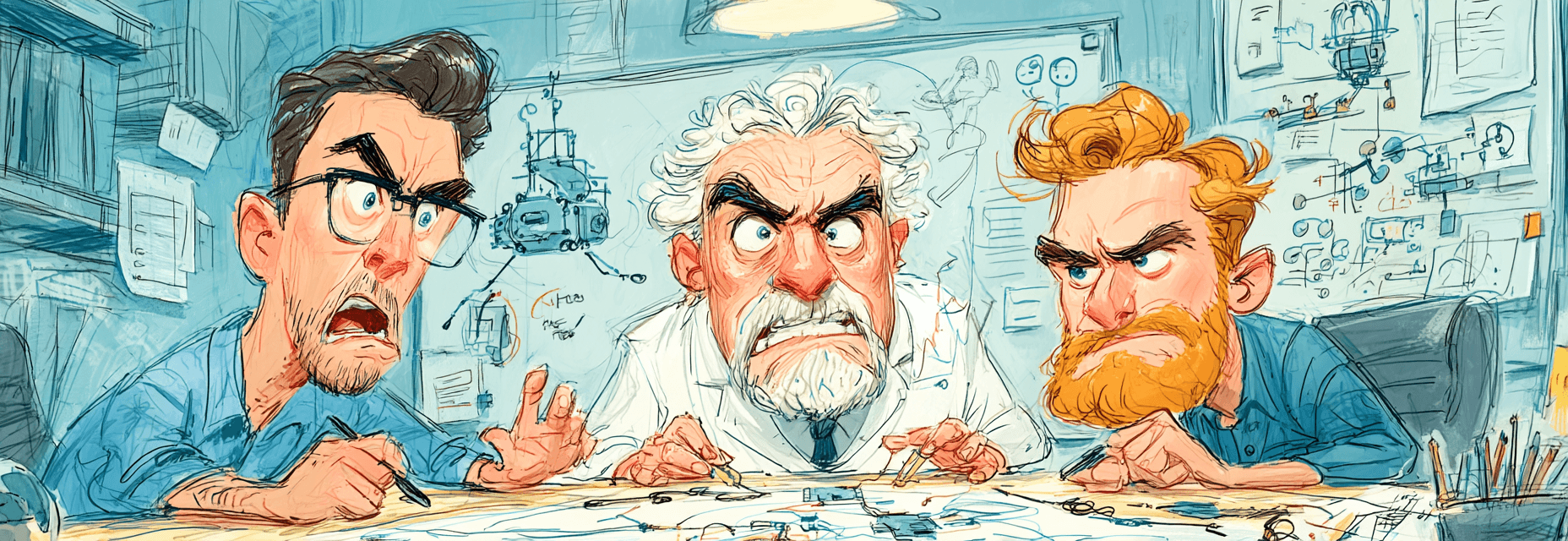
Everyone talks about alignment. But alignment is a fantasy when the models and the code live in different realities. Strategy teams map elegant diagrams. Engineers inherit a screenshot with no context. Between them? A gap no one owns.
The modelling to engineering handoff is treated like a logistics problem—pass the baton cleanly, document well, use a ticketing system. But it's not a logistics problem. It's a translation problem. One side thinks in systems, the other in syntax.
And unless someone is fluent in both, your transformation is a slow-moving collapse.
The Myth of the "Clean Handoff"
The idea of a clean handoff assumes a level of maturity and mutual understanding that doesn’t exist. In reality, most transformations are rushed, political, and already under pressure when the handoff happens.
So you get defensive modelling—over-abstracted, vague, and filled with placeholder fields. You get interpretive engineering—developers filling in gaps based on previous assumptions, tool limitations, or deadlines.
This isn’t collaboration. It’s guesswork. And guesswork scales failure faster than any AI model ever could.
A Real-World Wreck
At one major health insurer, the data strategy team spent eight months designing a pristine enterprise model for customer data. It ticked every compliance box, aligned with regulatory structures, and even included predictive attributes.
Engineering got a handover deck, three Visio exports, and a 600-row data dictionary with no usage scenarios.
Three months later, the warehouse had thirty tables with names that didn’t match the model. The inferred keys were missing. The gold layer was built, but the business couldn’t trust it.
The model was right. The build was right. The translation was broken.
And in digital transformation, that’s enough to kill momentum permanently.
Why Most Architects Can't Save You
People assume the solution is architecture. Hire an enterprise architect, make them the bridge. But most architects still lean one way—too abstract to code, or too technical to question the model.
Worse, their incentives are political. They smooth tension instead of surfacing it. They defend what’s already broken because rework is career suicide.
You don’t need another interpreter. You need someone who can redesign the entire conversation.
What Actually Works
The only way to survive the modelling to engineering handoff is to kill the handoff entirely. Create a closed-loop system where modelling and engineering sit in the same feedback cycle.
Treat the model like source code. Version it. Test it. Break it early.
Instead of a document, ship a prototype. Instead of a sign-off, run a build. Make your models executable. Or at the very least, traceable to outcomes.
And most importantly, assign translation as a skill, not a phase. It’s not a stage in the project. It’s a role. Someone who can challenge both sides, ask real questions, and force coherence before anything gets built.
The Pain of Getting It Right
This approach slows the start. It makes stakeholders uncomfortable. It forces people to admit what they don’t know.
But it’s the only thing that scales. Because once you lose trust in the model, you lose trust in the platform. And once you lose trust in the platform, your transformation becomes lipstick on legacy.
Not because your engineers were lazy. Not because your model was wrong. But because no one thought translation mattered.


Read next

Human-Centered Transformation
Transformation Fails When You Don't Translate
Your team isn't resisting transformation — they can't decode what you're asking them to do. Strategy language is abstract by design; without deliberate…
4 min read

AI as Strategy
Why AI Projects Fail at Week 7: It’s Not the Model. It’s the Org
AI pilots don't die because the model breaks. They die in Week 7, when the model works well enough to expose bad data, misaligned incentives, and the people…
4 min read
Human-Centered Transformation
Building AI Trust Between Teams
AI programs don't fail in production — they fail before deployment, when cross-functional trust collapses. Governance structure, not culture work, is what…
5 min read