 Archos Labs
Your AI Tool Isn't Broken. Your Data Is
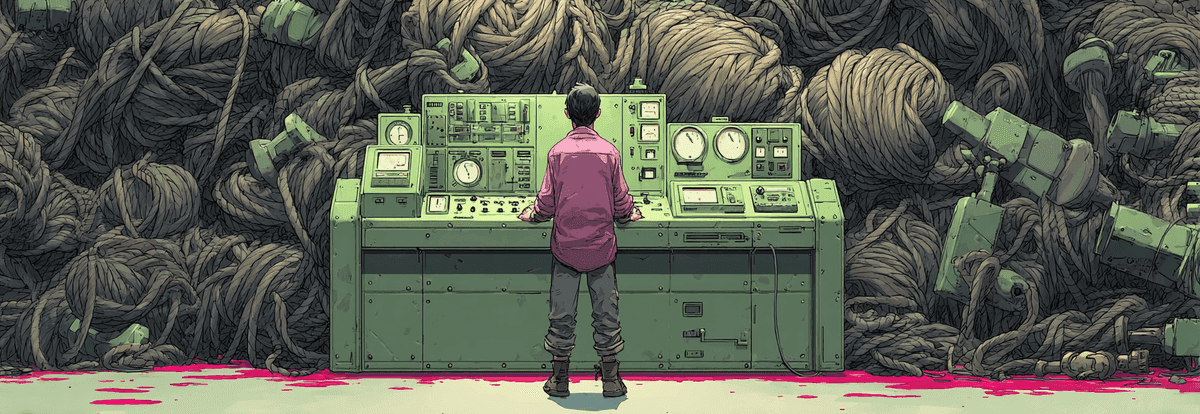
42% of organisations name data quality as their top AI failure point in 2026. The model isn't the problem. Here's what founders keep missing.
You switched from ChatGPT to Claude. Output got worse. You switched back, rewrote every prompt, watched a YouTube tutorial on prompt engineering, and the answers are still inconsistent. The tool feels broken. It probably isn't.
The thing founders keep blaming
When an AI tool produces unreliable output, the instinct is to adjust what you can see — the prompt, the platform, the settings. This is rational. The tool is the visible part. You type something in, something comes out, and when the output is wrong, the input box is right there waiting for you to fix it.
The problem is that the system you're adjusting sits on top of a layer you're not looking at.
IBM's 2024 data quality research establishes that profiling, cleansing, and validation have to happen before AI use, not after you've already noticed the outputs are bad. TechTarget's 2024 analysis links missing values, duplicate records, and inconsistent formats directly to unstable model behavior. Rodney Warner, writing in 2024, attributes business AI failure specifically to messy data and inconsistent formats rather than the tool itself. These aren't edge cases. They describe the default state of most small business data.
What bad data actually looks like in practice
Your CRM has three entries for the same customer with different email addresses. Your product descriptions were written by four different people over two years and use different terminology for the same items. Your sales data has a column called "status" where someone typed "closed," "Closed," "CLOSED," and "done" to mean the same thing. You fed all of this into an AI tool and asked it to summarize your best customers.
The model did exactly what it was supposed to do. It processed what you gave it. The output was garbage because the input was garbage. AIMultiple's 2026 analysis applies the GIGO principle directly to AI agent workflows: output quality traces to the accuracy and consistency of the data underneath, not to the capability of the model sitting on top of it.
Smarte.pro's 2024 SMB-focused analysis adds a concrete threshold claim — if your data error rate exceeds 15%, the AI tool compounds the error across the pipeline. That figure isn't peer-reviewed, so treat it as directional rather than definitive. The direction it points is clear enough.
The counterargument that's worth taking seriously
IBM (2024) and TechTarget (2024) both make a point that complicates the clean version of this argument: fixing the data doesn't fix the problem when the tool chain itself is wrong. If your retrieval system is pulling the wrong documents, or your model was never retrained after your product line changed, clean data won't save you. TechTarget treats model monitoring and retraining as distinct operational requirements, not downstream effects of data quality.
This is a real constraint. [Inference] A founder who cleans their entire CRM and still gets bad output probably has a retrieval or configuration problem, not a data problem. The thesis isn't that data is the only failure point. It's that data is the failure point founders check last, when it should be the one they check first.
ClarityArc Consulting's 2024 guidance puts it plainly: the starting point for poor AI results is a data quality assessment tied to the specific use case. Not a prompt audit. Not a platform comparison. A data audit.
Why the tool gets blamed anyway
I spent three months convinced that a particular AI writing tool — I'll name it, it was Jasper — was producing repetitive, off-brand output because of something wrong with its model. Rewrote my brand guidelines prompt six times. The actual problem was that the examples I'd fed it as reference material were inconsistent. Half were from before a brand refresh. The model was averaging across two different voices and producing something that matched neither. Cleaning the reference set fixed it in an afternoon.
The tool was fine. The data was not.
Encord's 2024 research on production AI systems argues that model quality in deployment depends on collection quality and labeling consistency, not on model architecture. A well-configured system running on bad data produces consistently bad output. Not intermittent bad output that retraining would fix. Consistent bad output, because the signal it's learning from is consistently wrong.
Before you submit another support ticket or buy a new subscription, open your data source and look at what's actually in it.


Read next

Data as a Decision Infrastructure
Your AI Agent Is Lying Because Your Data Is Broken
Before you build an AI agent, audit the data it will actually use. Four failure modes founders miss and the checks that catch them before the rebuild.
3 min read

Data as a Decision Infrastructure
Bad Data Is a Strategic Liability
Bad data isn't an IT problem — it's an executive failure. Before you scale AI, you need to own what your data actually looks like and who's accountable for it.
4 min read

Data as a Decision Infrastructure
Data Quality AI: Fix the Leaks Before You Scale
Scaling AI on flawed data multiplies bad decisions faster than it creates value. A focused 90-day audit on two critical data domains stops the compounding…
4 min read